
Beach town report #1
Our new country suggests that every contradiction has a complement.

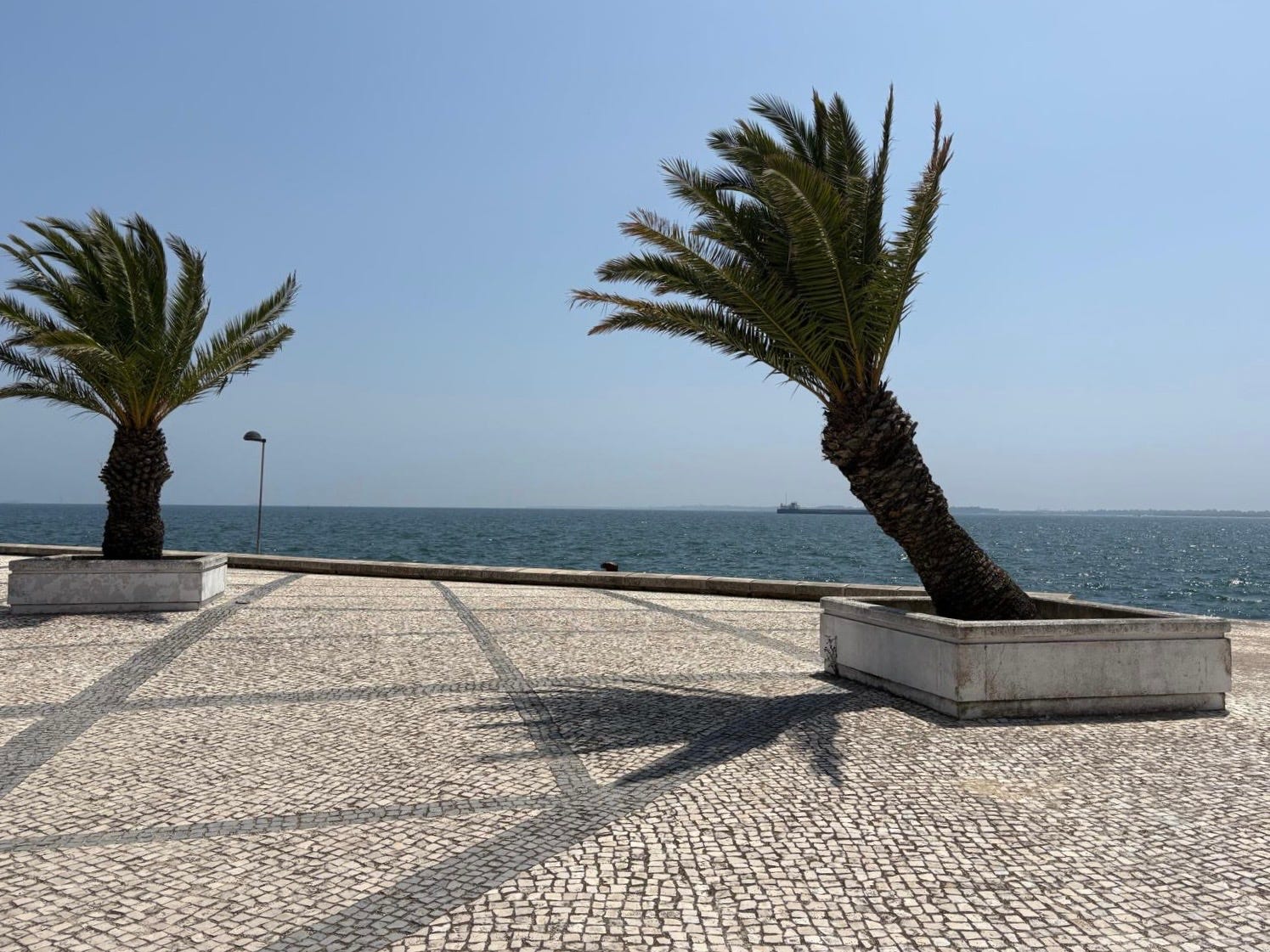
I always wanted to live in a beach town.
As a kid in landlocked Nebraska, I was never content with the far horizon of a place that merely used to be an ocean. My first favorite TV shows were “Flipper,” where a dolphin was Florida’s equivalent of Lassie, and “The Undersea World of Jacques Cousteau.” As I got a little older, all the cool kids on TV lived in California. Half the music on the radio was about California (and a song about Jacques Cousteau, by John Denver, was also a hit). I made it to California for college but was too young and dumb to stay on that coast; grad school in Boston put me on the other coast, within weekend driving distance to Provincetown, on Cape Cod, but I didn’t stay there, either (lots of us made poor choices in the ‘80s). I built a good life back in the landlocked Midwest, but never gave up the beach town dream.
Now I live in a beach town. One with its own legendary dolphins.
“Be sure to take plenty of photos of your new home nation and post a few to break up the seriousness of your Substack,” one friend wrote to me a few weeks ago. “We both know how much of a 💩 show things are going, but I try to let my mind focus on other stuff occasionally so that the creeping Fascism doesn’t totally harsh my mellow!”
I’m sorry to tell my friend I can’t post only the pretty pictures. I might be officially retired but I haven’t shaken off my sense of journalistic responsibility; also, my brain’s simply wired to engage with hard truths. One of which is: To live in a beach town, I had to leave my home country. Another: My wife and I have unquestionably moved to a country of astounding natural beauty, yet for every gorgeous view there’s a complicating contrast.
As I noted last week, Portugal is known for its gorgeous artistic sidewalk paving tiles – but people here are not in the habit of picking up after their dogs, so the charming calçada portuguesa sidewalks are also dolloped with 💩.
Our town encourages environmental responsibility with three recycling bins and a dumpster on nearly every block. But they’re often overflowing, which creates a litter problem.
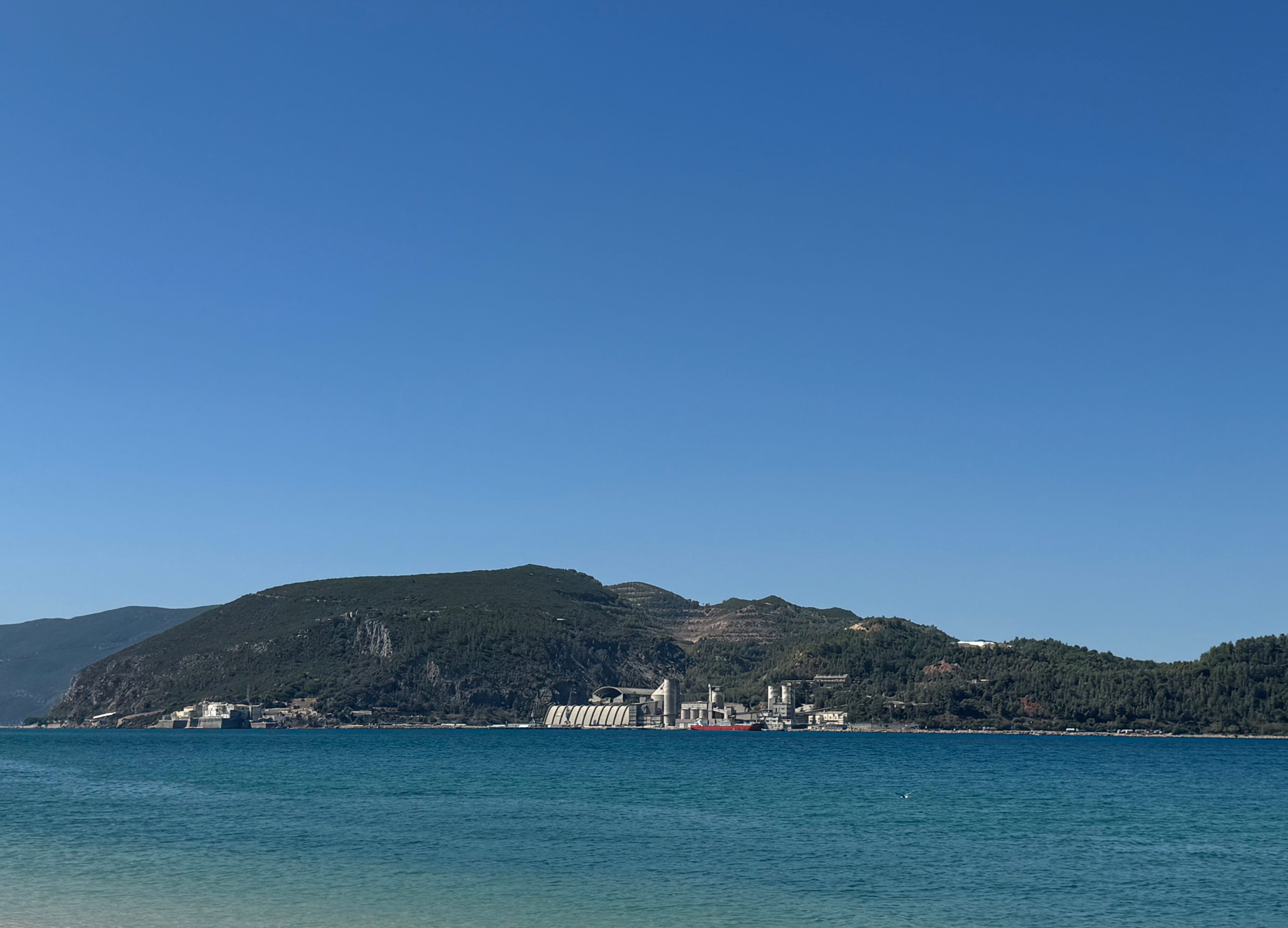
We’ve been to four beaches and still haven’t visited all of them within distance of a walk or a bus or ferry ride. All of them are gorgeous. From all of them we can also see the cement factories at the foot of the nature park or the enormous ships carrying cars, oil, or, according to my wife’s ship-tracking app, “general cargo” to the working port at the east end of town.
From our apartment, if we walk a couple of kilometers in one direction we’ll arrive at the waterfront, where restaurants sell platefuls of fresh seafood in the charming old-Europe town center.
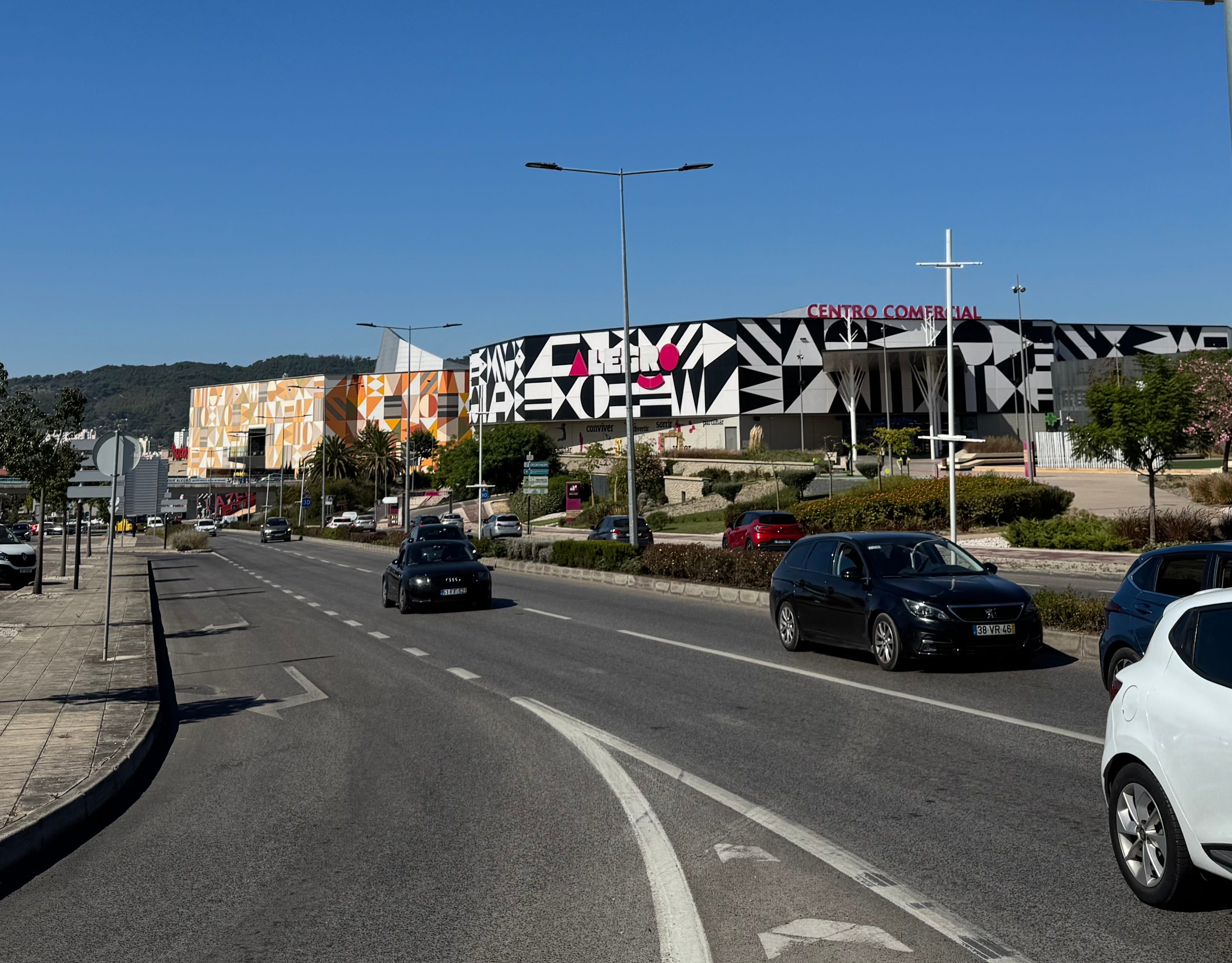
If we walk a couple of kilometers in the other direction, we’ll arrive at a suburban-style mall anchored by an Auchan (like a super-Target) and Leroy Merlin (like a Home Depot), both global retailers controlled by a family of French billionaires.
Our fellow expats describe the town as gritty, which we like. It’s not one of the polished places where high-end retirees from all over the world — not just the U.S. — are driving out Portuguese families. On nearly every block, there’s an empty, overgrown lot or a falling-down but still-gorgeous, centuries-old building. But a beach town can’t remain undiscovered forever, and luxury high-rises have been built or are under construction in every direction. People who grew up in town remember when they could take the ferry over to the gorgeous beaches at Tróia for just a couple of euros. Tróia is now home to a high-rise casino and a ticket over and back on the ferry is ten euros — unaffordable for a family day trip.
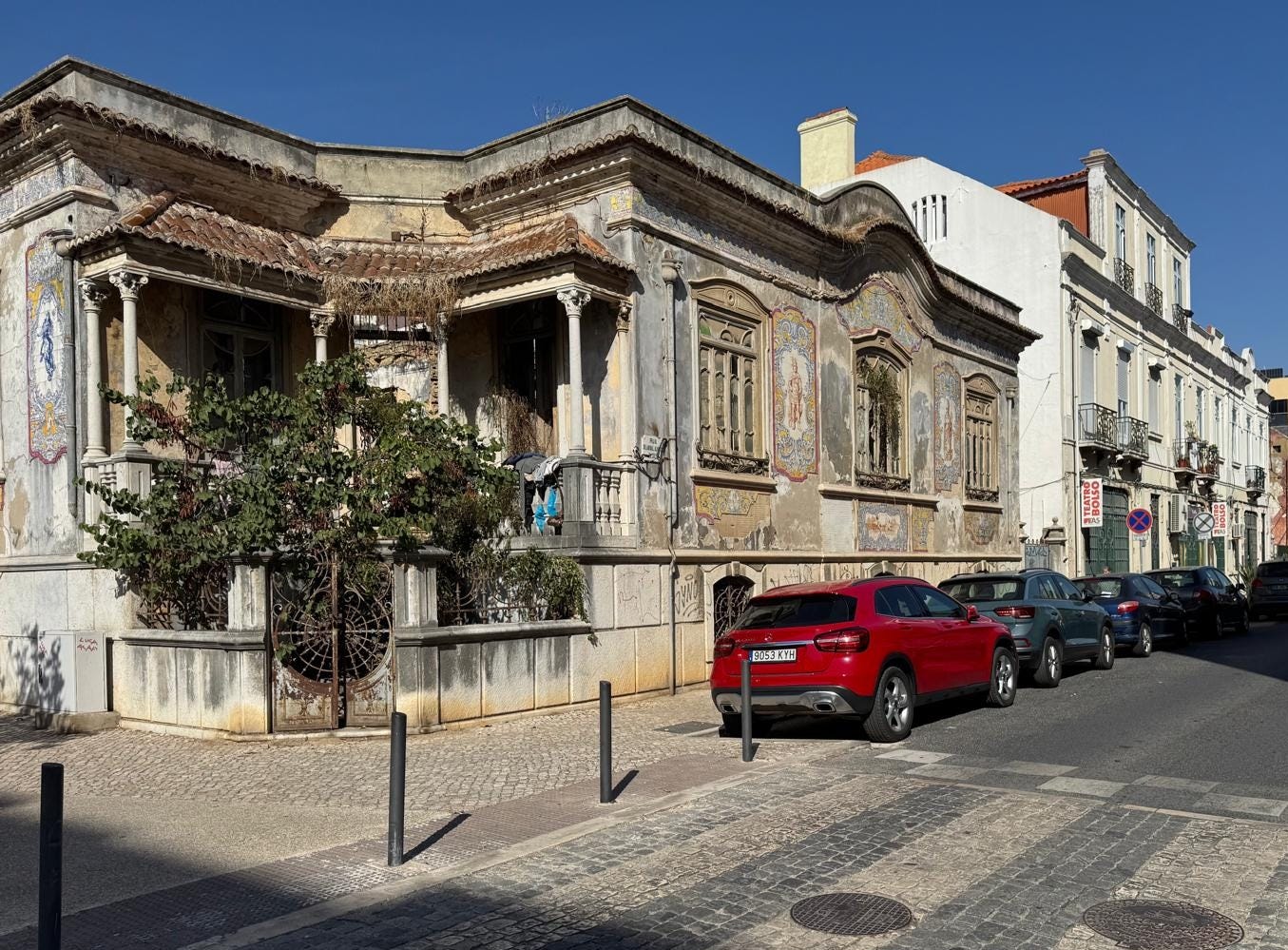
Portugal tolerates graffiti, which to American eyes signals dangerous neighborhoods. Yet Portugal is the 7th safest country in the world, according to this year’s Global Peace Index (the U.S. comes in at number 128, just after Kenya).
There aren’t a lot of rainbow flags flying in our new town, which only this month held its first Pride march. But as a gay couple, my wife and I feel safer here than in our home country.
Being able to leave a political situation on our own terms and landing in a comfortable apartment with an ocean view are extreme privileges for which we are deeply grateful. We’re also heartbroken and angry, as are all of the loved ones we miss. These earliest weeks in our new country, we’re in a constant state of comparison and contrast: daily life here vs. daily life back there as we get our physical bearings; what we’ve gained vs. what we gave up as we nurture our mental and emotional health.
Describing our earliest impressions in terms of comparison and contrast feels too simplistic. But it also feels like a reminder of how to be human. A rediscovery, at age 62, of basic tools for interpretation and learning.
And so far, the similarities between our old life and new life have been eerie.
I started my adult life in the San Francisco Bay Area and always hoped to make it back someday. But in the last decade of my career, even if I got a job there (and I did have opportunities), I couldn’t have afforded to live there. Now we’re living on a west coast where the geography’s a lot like California’s. From our balcony, if I close my eyes and squint, the hills and the ocean resemble my favorite Northern California beach town of Santa Cruz. We weren’t thinking about any of that when we chose this town. We chose this town because we know some folks here, so we’d at least have a couple of friends in our new home. But it might be as close to the feeling of the Bay Area, geographically at least, as is possible in another country.
Our town is about 30 miles south of Lisbon, connected by a structure that looks a lot like the Golden Gate Bridge.

Lisbon’s Golden Gate lookalike is named the Ponte 25 de Abril, celebrating a date associated with the fall of Portugal’s fascist dictatorship in 1974. Back in our home country, a fascist dictatorship has taken control. Now in Portugal, an increasingly popular far-right presidential candidate is following the U.S. president’s playbook. The far-right party didn’t do nearly as well as it had hoped in this month’s municipal elections throughout the country, so we’ll wait to see whether that means it’s lost momentum or it’ll just regroup to come back stronger.
The thing about living in a beach town is that, when everything feels overwhelming, you can always just go to the beach.
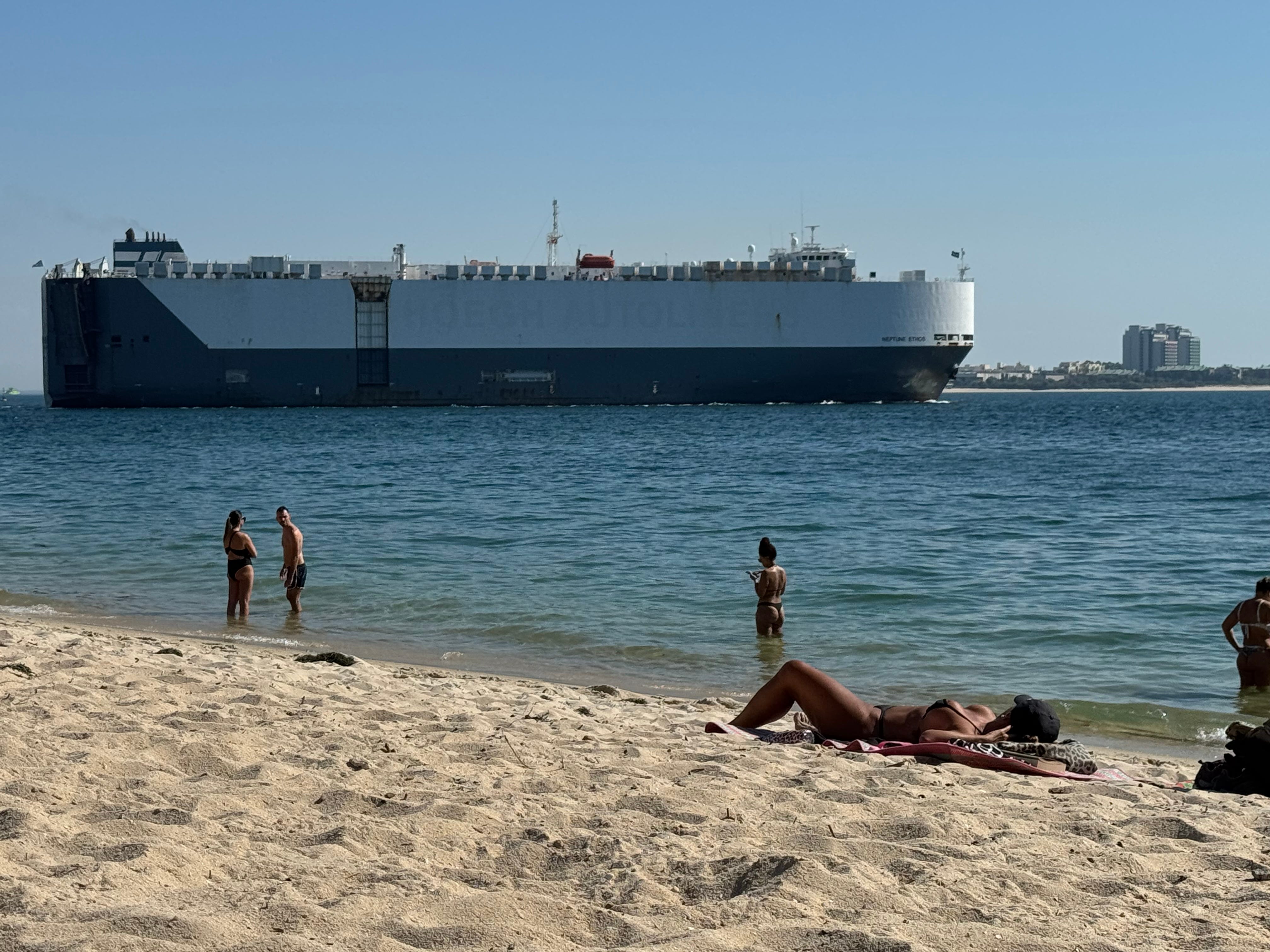
So far, my wife’s app has identified ships flying flags from Greece, the Netherlands, Norway, the UK, France, Spain, Cypress, Liberia.
At the beaches, we’ve seen sunbathers of all different skin colors. Besides Portuguese, we’ve heard them speaking Italian, German and (we think) Russian, and English with accents from different countries in the UK and Ireland. We met a group of women who were cousins meeting up here from Canada and France.
From these beaches it’s so easy to see how the whole world is connected. Which might be the most beautiful revelation of this whole situation. Also the saddest, because so many of us keep fighting.
Your town sounds beautiful! I’m also originally from California, but have lived in the Netherlands for a decade. It’s so striking to me how different Americans who’ve just left sound. We came for the adventure; those like you leaving now sound like you’re fleeing. It’s a bizarre experience to feel myself turning into an exile as the place I left behind changes so much it become unrecognisable as home.
Hi CJ! Nice article!