
'Our struggle is one'
An old familiar ritual welcomes us to our new town.

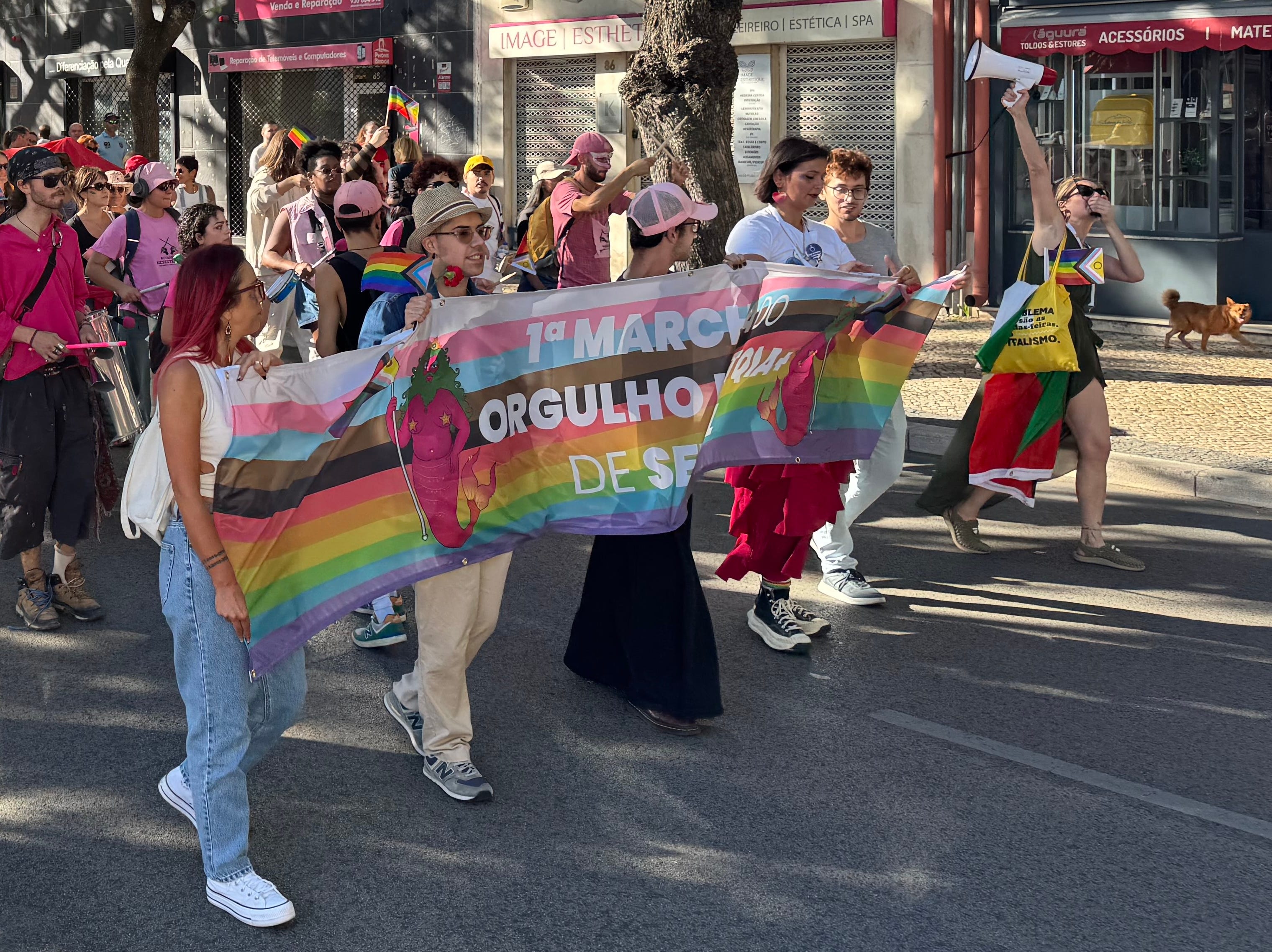
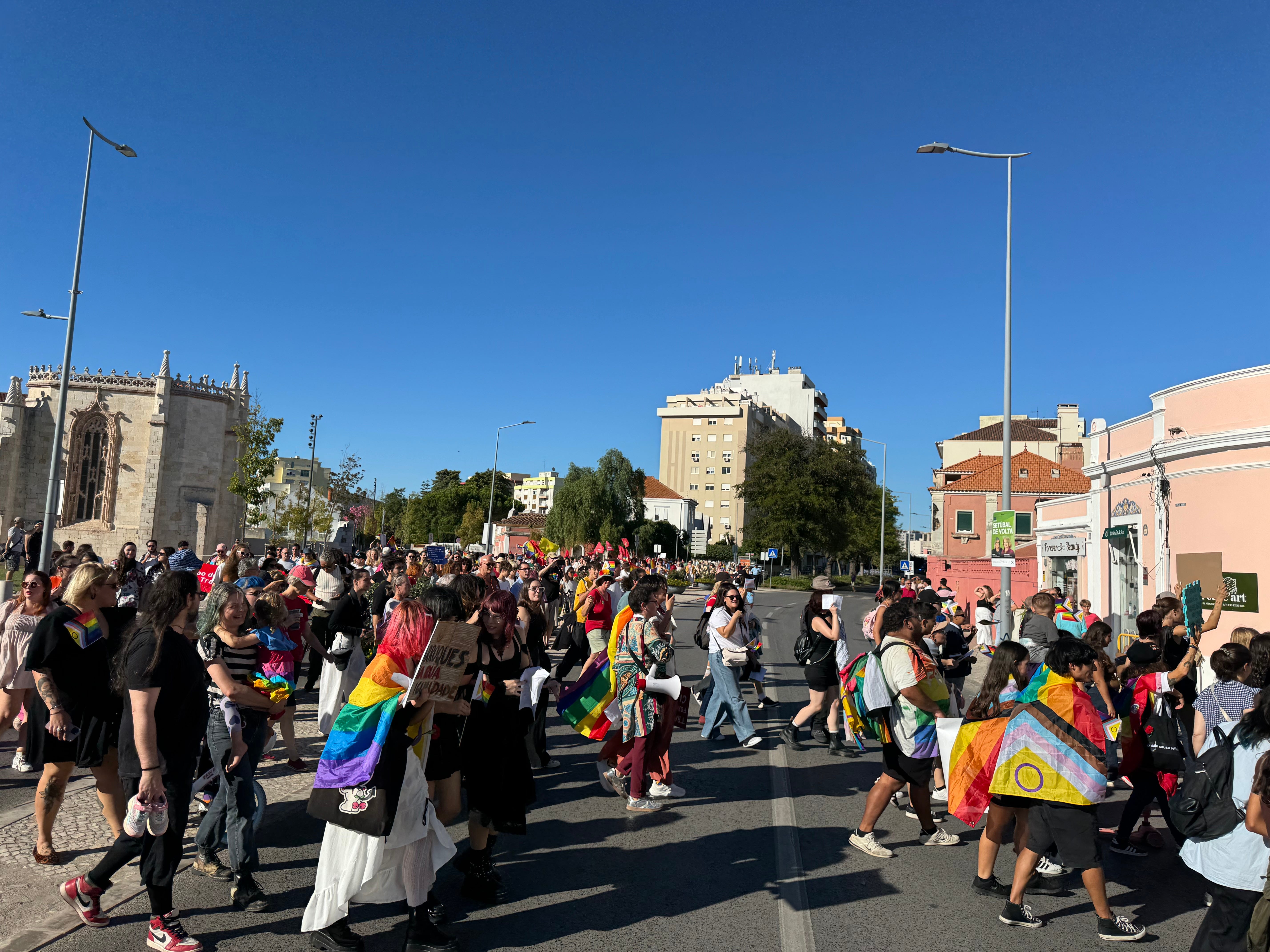
Last Saturday, people in our new town did something they’d never done before. They marched for LGBTQIA+ Pride.
Why they’d never marched before, when millions of people all over the world have done so for decades, I don’t know. It’s a town of just under 125,000 people, so, not a small town. And it’s not far from the capital city of Lisbon, so, not out in the rural, more conservative part of Portugal. Based on Facebook conversations, I know some locals were predictably unhappy that such a march was happening here, which only helped prove to others that such an event was necessary.
In my previous life, I’d be able to tell you all about this event. Who organized it, why this year, why on that particular Saturday, why it started at 4 p.m., whether they had any trouble getting a permit to close the streets, and did they really have to change course at the last minute because the far-right Chega political party was having a rally in the city’s main plaza that was originally on the Pride marchers’ route.
I’d probably have approached one of the numerous (and handsome) polícias standing around looking relaxed on sidewalks all along the route, and asked them to comment on the day’s duties. I might have even stopped to ask one of the (very few) grumpy-looking observers waiting to cross Av. Lísa Todi what they were thinking.
I’d be able to tell you what people’s signs said and what they were chanting.
But I’m new in town, in a country where I don’t speak the language. Asking people these kinds of questions, which I used to do professionally, requires establishing a minimum level of trust, at least if you want legitimate answers and especially if you intend to publicize those answers. Not knowing anything about a topic I once wrote a whole book about felt weird. I’m retired, I reminded myself, and under no obligation to report any of this to anyone. Old habits die hard, though, so when I saw a clear opportunity along Av. 5 de Outubro, I hustled ahead and stood on some stairs in front of a building to get the whole march on video. It took three minutes and eighteen seconds for the entire procession to pass, give or take the polícias bringing up the rear.
I keep rewatching it for favorite moments and characters, and finding new ones each time.
Thanks to the QR code on fliers posted around the city center, I now know that the march was organized by a local group called the Qardume Coletivo and supported by local and national organizations and many individuals who agreed to be listed on the website where they also posted their manifesto. Google Translate tells me it’s beautifully written:
Dreamed and built by us, a group of lesbian, trans, bisexual, gay, queer, intersex, asexual, aromantic, and other people, and also by people who are none of these. We are mothers, fathers, grandparents, aunts, family members, friends... We are the people you see every day on the street, on the bus, at work, at school, in finance, in the bread line and behind the counter, in government, and in prison.
But there are too many people these days telling lies about us. We are not the monsters they create in online videos and speeches. This March is an opportunity for you to put down your cell phones and see us in the flesh. We are Setúbal. Periphery and center, center and periphery.
Among the group’s goals, according to the manifesto, is sex education. I was struck by their practical, wise description of why that’s such a basic need:
We know countless stories of people who were sexually abused in childhood; or who, upon getting their first period, cried, thinking they were dying, or hid their underwear under the bed; or of people who became pregnant as teenagers or contracted a sexually transmitted infection; or who were forbidden to wear certain clothes at the request of their partner. Let’s not be afraid of our bodies. The body is the most beautiful tool for living and being in the world. When we ignore or hate it, we become easier to subjugate, control, and mold, and that’s what the masters of society want.
Citing police raids over the past year on spaces in Lisbon “frequented by trans and racialized people,” the manifesto says organizers decided it was time to march in Setúbal because they wanted to live in a “more inclusive city” and “build community.” Noting that the city is segregated, they say many buildings and services are inaccessible and “there are so many homeless people and so many homes without people.” Marching is about more than the LGBTQIA+ issue, they write. “Everything is connected. Our struggle is one.”
Portugal is one of the world’s most queer-friendly countries, but we all know better than to take such things for granted.
So my wife and I and a few of our new expat friends joined in, flowing with the crowd, enjoying the glorious sunny day and supporting the locals as they made their own history.
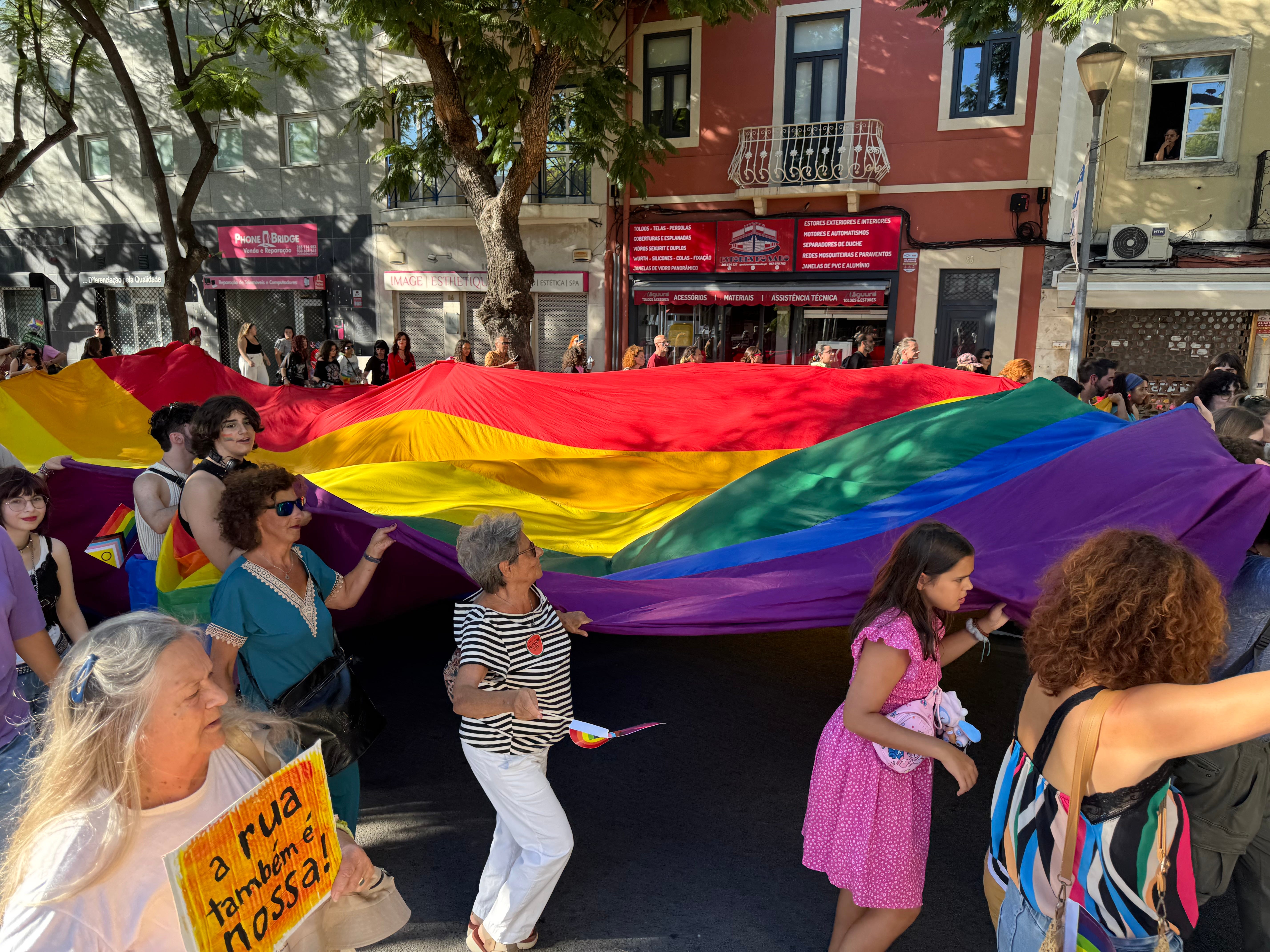
One of our new expat friends said the day reminded her of her first Pride marches in New York City in the early 1980s. My first Pride, in San Francisco in 1982, was a parade with 400,000 marchers and spectators, so this one reminded me of more recent Prides in small Kansas towns. A contingent near the front of the march carried an enormous rainbow flag, the same size as the one Equality Kansas carries on marches around the Statehouse in Topeka each year on Equality Day, also the one at the front of the 2019 Wichita Pride parade that makes an appearance in our documentary No Place Like Home: The Struggle Against Hate in Kansas — it was fun to imagine that queer Kansans had somehow donated their giant flag to their brothers and sisters in Setúbal, sending it across the Atlantic in honor of the day.
Meanwhile back in actual Kansas, headlines a couple days earlier were about how the state legislature was once again attacking transgender folks. “Republican legislative leaders are urging lawmakers to support their push for a special session where they can both ban Kansans from altering gender markers on their driver’s licenses and redraw congressional maps,” reported my old boss Sherman Smith of Kansas Reflector.
It should be obvious to everyone in America, by now, that transgender people aren’t the problem. That the anti-trans rhetoric of the past few years is just one piece of the enormous con job that is scapegoating easily targetable minorities so a few weak boys can live out their violent strong-boy fantasies.
A lot of people in Setúbal’s streets last Saturday were old enough to have experienced Portugal’s fascist Estado Novo regime, which ended in the 1970s, and the younger marchers clearly didn’t want to repeat it. America’s refusal to learn from other countries’ histories is one reason my wife and I left.
As Setúbal’s marchers made their way to the Praça José Afonso, a plaza named after a protest singer whose music helped bring down the dictatorship, a new Portuguese friend translated one of the chants for us.
“Nem menos, nem mais, direitos iguais,” they shouted in a familiar rhythm. It translates to “no less, no more, equal rights” — a righteous declaration in English that sounds a lot better in Portuguese.
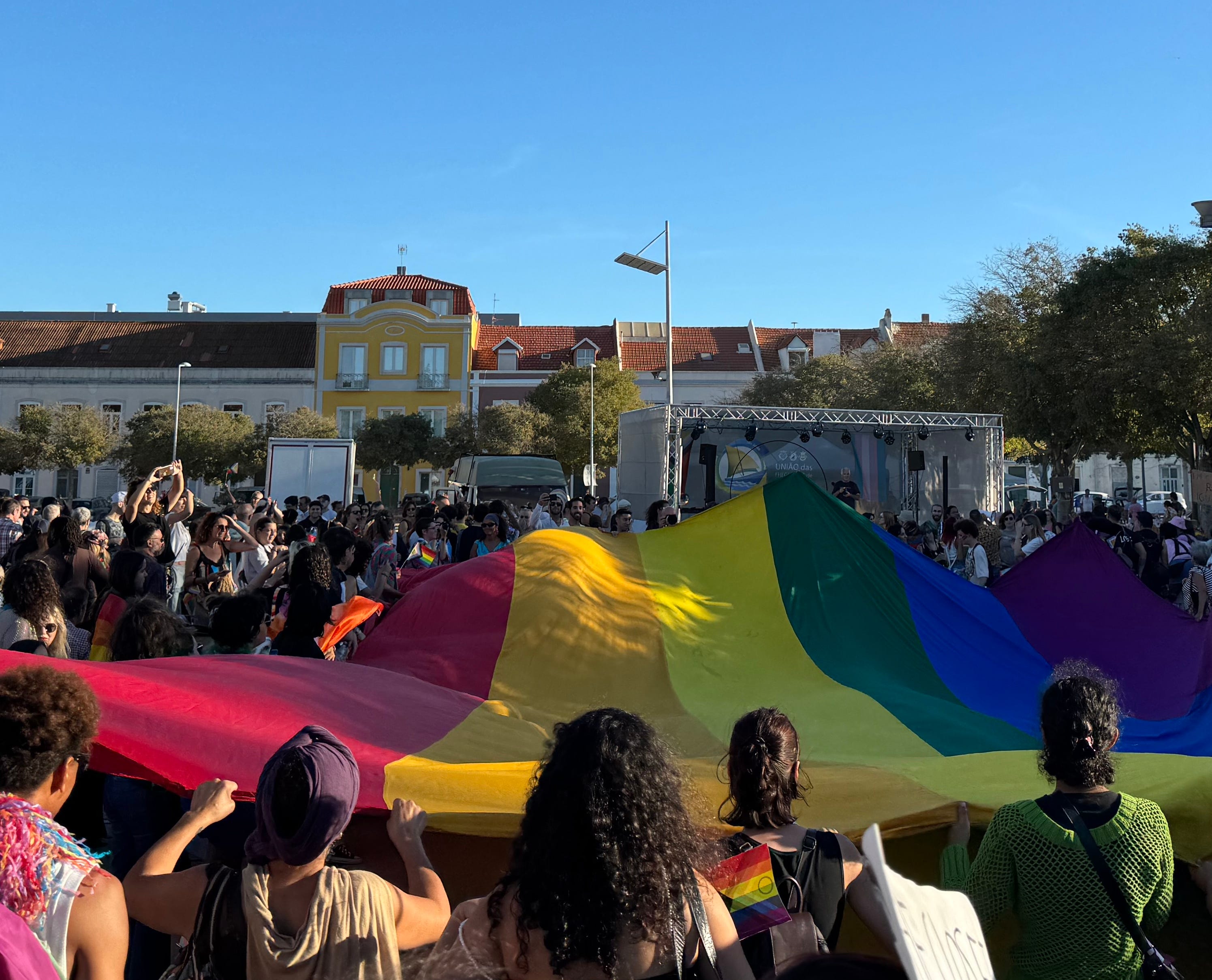
I hope the organizers of Setúbal’s first Pride march were gratified by the turnout, that they felt the same joy as those of us who’d been to many (many) marches also felt that day. I hope they have another one next year. By then we’ll know more people in the crowd, and more of the words on signs.
Until then, I have a message for Qardume Coletivo: Thanks for giving this old, exhausted, cynical American gay gal a Saturday of pure, raucous fun with strangers we know well.
Bonus gay stuff! I’m pleased to share that the super cool literary magazine sneaker wave has published my essay boys of the 70s, about growing up trying to like boys because I thought I was supposed to. (Content warning: it has cringy scenes from my teen sex life, which is likely TMI for some readers who probably know who they are.)
A beautiful read on National Coming Out Day - thanks for sharing the joy in such detail!
What a terrific welcome for you, and a nice ray of sunshine after the turbulence you left behind. Congrats.