
Endless Pride
It's June. Forgive me for having too many mixed feelings.

Pride month messes with me.
Rainbow flags go up all across the world, my queer family erupts in exuberance and our loved ones cheer us on. Enlightened politicians declare their support and (some) businesses suggest we’re their favorite customers. June’s glorious global celebration is real, yet it’s so far beyond what I could have imagined when I came out.
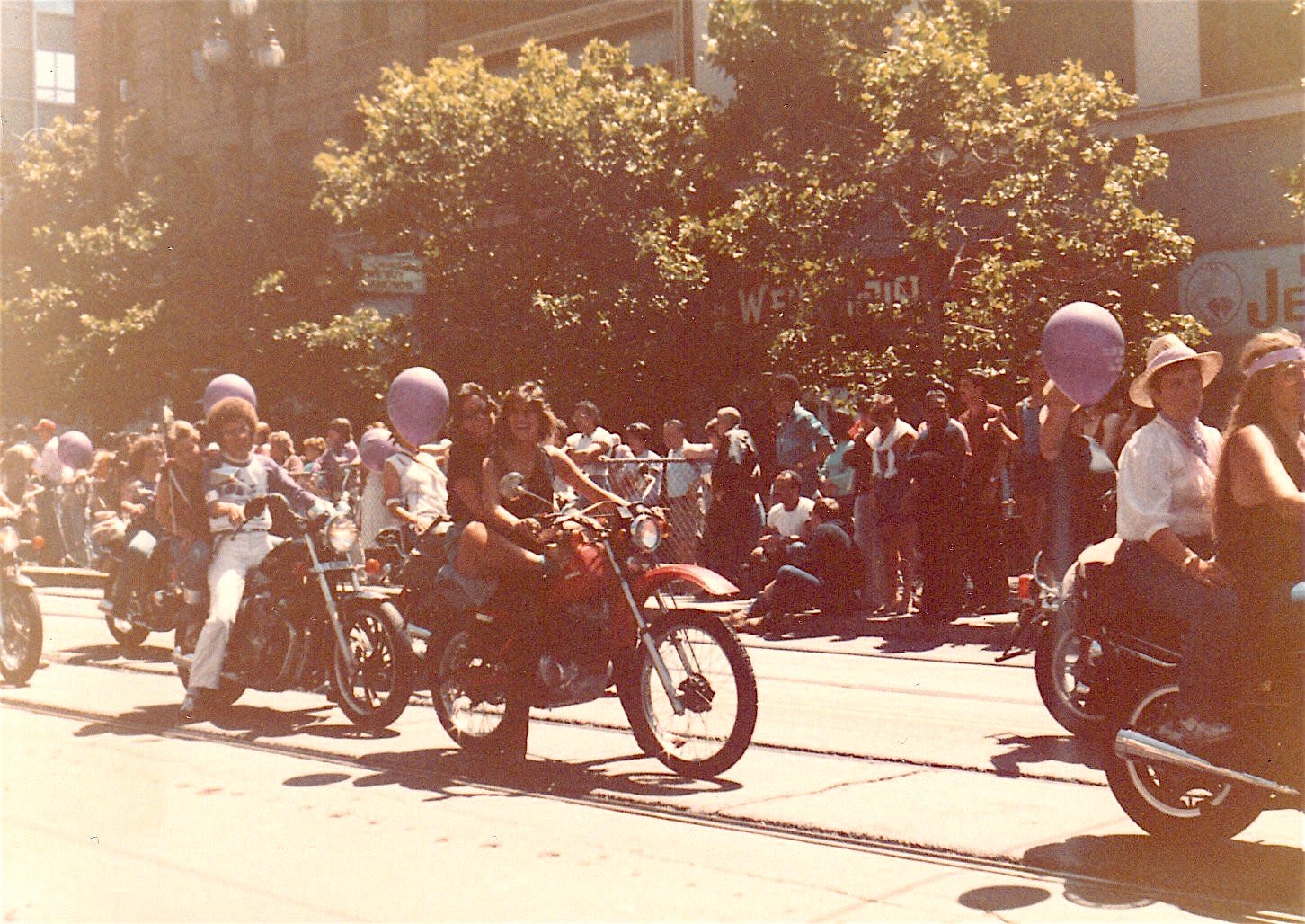
It was illegal to be gay back then. We had no rights in the United States. If I saw the word “lesbian” in a newspaper, it likely had to do with a Navy scandal in which 24 women sailors aboard the USS Norton Sound were accused of being lesbians, investigated and pressured to name names of lesbians. Like countless gay kids before me, I left my Midwestern home for San Francisco. Pride was just one day, always the last Sunday of June, and I went to my first one in 1982. I was 19. The number of people along Market Street was at least twice the population of my home town.
It was the dawn of AIDS. And June, I would learn, was also the month when the U.S. Supreme Court usually ruled against us. So we had to fight for our lives.
After graduate school on the East Coast, I landed in Kansas City, where my earliest days as a journalist coincided with the rise of Fred Phelps and his Westboro Baptist Church. Phelps and his children had just started staging their “God Hates Fags” protests in towns beyond Topeka; over the next couple of decades, they took their act national and then international. Phelps and Westboro were, I concluded, Kansas’s number-two global export, after wheat.
I was working at the alt-weekly out west in Denver, a couple of hours south of Wyoming, when, in October 1998, two men picked up 21-year-old Matthew Shepard at a bar in Laramie, took him out to the country, beat him up, tied him to a fence and left him to die. That broken part of my heart has never healed.
Back in Kansas City, I wrote about political attacks against us as George W. Bush’s presidential campaign in the mid-2000s weaponized the mere idea of gay marriage, convincing huge majorities of voters in a couple dozen states to ban it in their constitutions. Then I followed the long legal slog that led the U.S. Supreme Court to reverse all of those bans and legalize marriage equality in 2015. It was extraordinary to watch public opinion change dramatically over that decade. Just as we’d done during the most devastating AIDS years, we fused love and anger to educate the country (enough of it, anyway) to earn acceptance and even, in some places, respect. We forced the world to make progress.
When I saw that progress happening in unexpected places — namely small towns in Kansas — I spent a couple of years driving all around the state to try to understand the nature of that change. People shared their stories of everyday bravery, sometimes powering through painful memories. “I’m telling you this,” they’d say, “because I don’t want anyone else to have to go through what I went through.” Receiving that kind of trust is a journalist’s greatest privilege. I tried to honor it by making sure those stories got out into the world.
After the 2018 publication of No Place Like Home: Lessons in Activism from LGBT Kansas, I was honored again by invitations to speak about it — especially during Pride month. The 2016 presidential election had shocked a lot of people into first-time activism. Tens of thousands of Kansans got busy protecting their queer family members and friends, and they started electing LGBTQ candidates to state and federal offices.
A terrifying backlash was gathering strength, though, targeting our whole community but especially transgender folks. I helped document this, too, with director Kevin Willmott and our team of filmmakers for No Place Like Home: The Struggle Against Hate in Kansas.
Long before the backlash hit full force, I watched as corporate-sponsored Prides began to lose their edge and just feel like parties. Queer joy is life-affirming and life-saving and its own political statement, for sure. But it got to the point where some elders and historians needed to send out reminders that Pride is a protest. In Kansas City, Pride hit a low point when it was mostly a drinking festival behind a chain link fence with a $10 ticket. Young activists rectified the situation a few years later, once again putting on proper parades and honoring elders. But the low point made it clear we’d grown too comfortable, let down our guard.
In fairness, all of America let down its guard — at least the part of America that believes in democracy, equality and liberty for all. Assuming America can halt the destruction any time soon, repairing the damage will take generations of hard work.
Some people never quit doing that work, of course, and it’s especially rewarding to write about the quiet ones. Which led to a bit of moving news from Kansas this week.
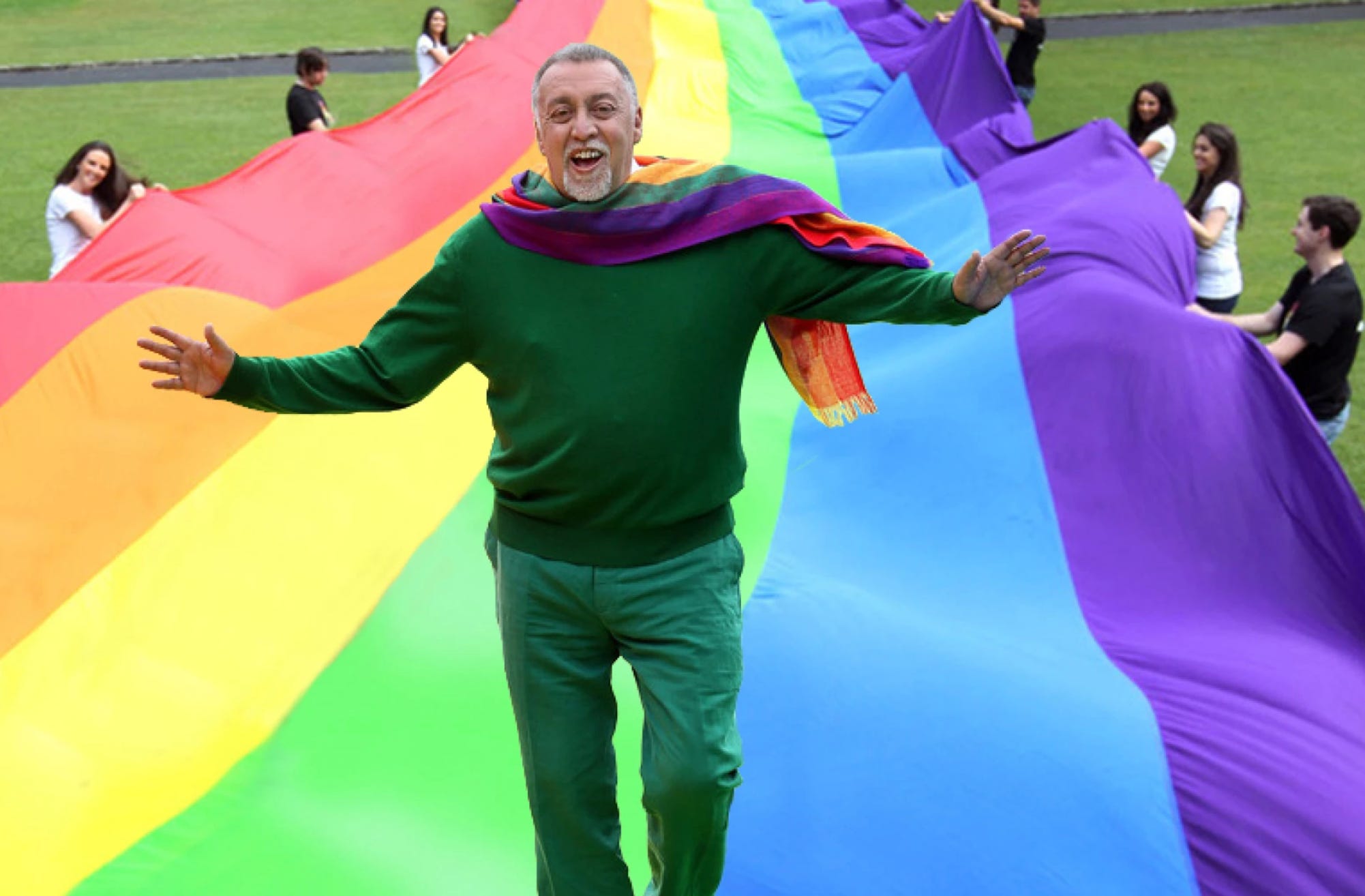
One reason Kansas has been such a fascinating muse is because it’s so unfairly yet so affectionately burdened as the home of fictional Dorothy. But it’s actually the home of a real man, the one who created the rainbow flag whose variations are currently flying everywhere.
When I learned that Gilbert Baker’s high school classmates wanted to promote his legacy, I headed to the southeast corner of the state, where members of the Parsons High School Class of 1969 welcomed me to their 50th reunion in October 2019. Once again people entrusted me with their stories. They had convinced Baker to come back to Parsons for a celebration in 2017, but he died a few months before his scheduled return. My first piece about their efforts ran six years ago in the public media outlet where I worked.
As the plans and players working to secure Gilbert Baker’s legacy changed, I had the opportunity to write an updated version of the story thanks to editors Thomas Averill and Leslie VonHolton, who included it in their recent Kansas Matters: Twenty-First-Century Writers on the Sunflower State.
It’s rare for a journalist to learn that her work has changed anything. Last week, though, Kelly Wall of Lawrence wrote to tell me that her book club had read Kansas Matters, and that she’d been inspired to request a proclamation from the governor’s office.
Kansas Gov. Laura Kelly agreed, and proclaimed June 2, his birthday, to be Gilbert Baker Day in Kansas.
Clay Wirestone of Kansas Reflector served as witness:
Inside the governor’s ceremonial office, group members realized that no one had actually brought a rainbow flag — the symbol for Pride Month and LGBTQ+ rights more generally.
No worries, Kelly told them.
She retreated into her actual office and returned bearing a rainbow flag coaster and a copy of Janovy’s book, “No Place Like Home: Lessons in Activism from LGBT Kansas,” which features rainbow stripes on the cover.
Crisis averted, the group took pictures with Kelly, the proclamation and the props. That was that.
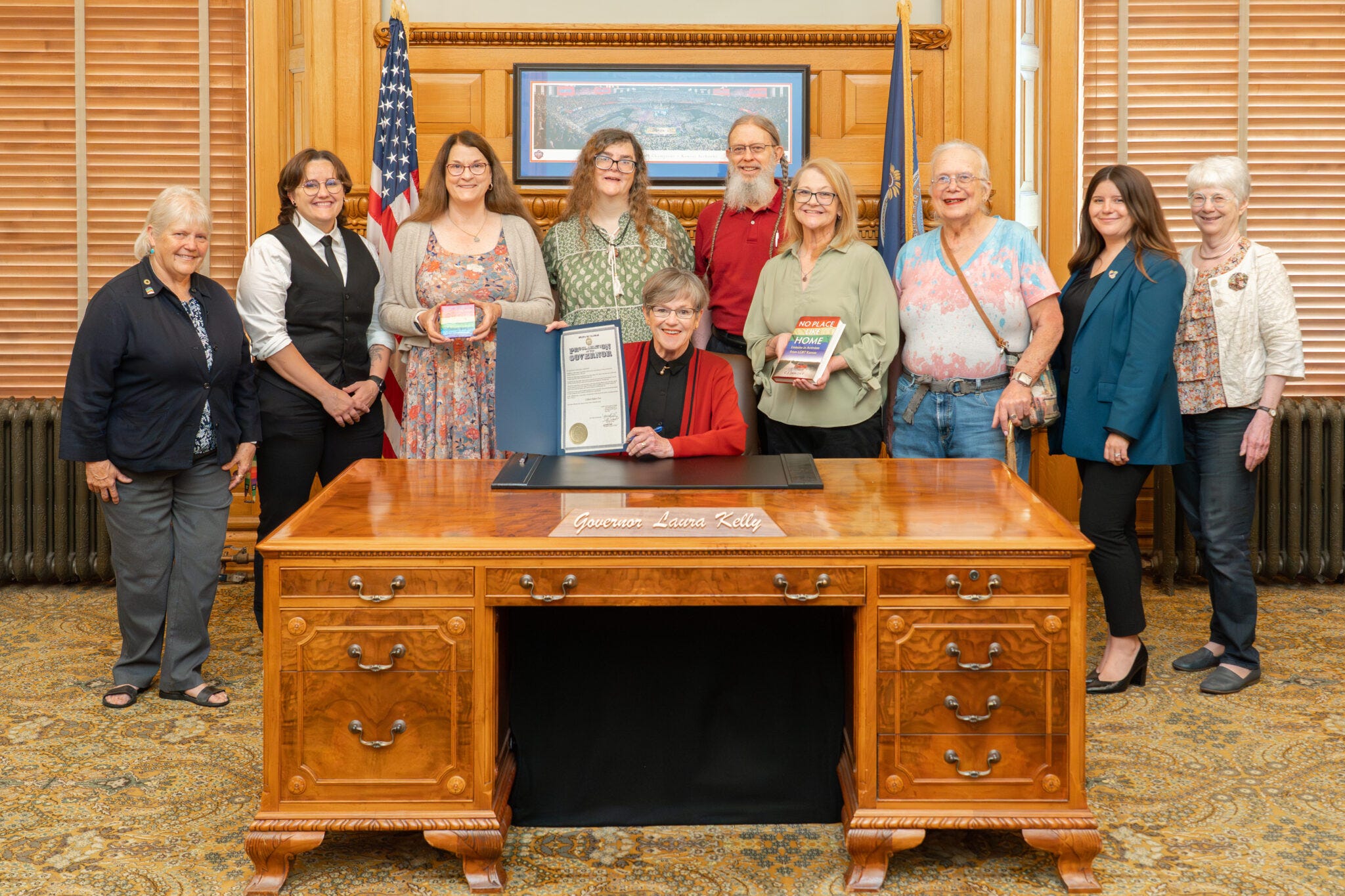
Considering everything else that’s happening in Kansas and the rest of America, a governor’s proclamation honoring an activist who left when he was 19 and never looked back is, let’s be honest, a small thing. Still, every Kansan needs to know that all those rainbow flags flying around the world right now are the legacy of their native son — whether they like it or not. And thanks to everyone involved, more Kansans now know Gilbert Baker’s name.
Small actions accumulate, motivate and generate. Gilbert Baker’s classmates started talking about his legacy, and now there’s a scholarship in his honor and a governor’s proclamation. A few dozen people fought back against police raids at New York City’s Stonewall Inn on June 28, 1969, and now the whole world sees queer resistance and beauty — including Gilbert Baker’s flags — every June.
Pride month messes with me because I’m wired to overthink. I can’t just relax and celebrate progress because I’ve seen how quickly and violently it can be reversed.
For now, though, I’ll do my best to celebrate: Today is Pride in Lisbon.
It will be my second Pride here, after our new town of Setúbal’s first Pride back in October. Portugal is one of the world’s safest places for LGBTQ people, but right-wing politicians are trying to reverse that here, too. I have a pretty good idea of what to expect from the day, but I’ll report back next week.
I'm engaged with your posts for many reasons. Your excellent writing, your lessons in history, your observations. But what I'm learning the most about is you and your personal history . . . and I love that.
I loved the whole piece and my comments would merely be echoes of comments already made by others. But I did want to highlight two statements that really struck me: “But the low point made it clear we’d grown too comfortable, let down our guard.
In fairness, all of America let down its guard — at least the part of America that believes in democracy, equality and liberty for all.” And “I can’t just relax and celebrate progress because I’ve seen how quickly and violently it can be reversed.”
I think you hit the nail on the head with those statements.
In the last few decades, we as a nation, thinking that progress was trending in the right direction (even if at times erratic and maddeningly slow) let down our collective guards and, tragically, we are seeing how quickly and violently that progress can be reversed. Present times have proven to us that the the old saw that eternal vigilance is the price of liberty is spot on.